Tuesday, October 11, 2011

Hackers Take Aim at NYSE

Thanks to David Goldman and CNN for the article

NEW YORK (CNNMoney) -- Anonymous' call for a massive attack on the New York Stock Exchange's website was met Monday -- but very, very briefly.

A group calling itself Anonymous, a name used by disparate groups of online "hactivists," threatened to take down NYSE.com at 3:30 p.m. ET today as an extension of the "Occupy Wall Street" demonstrations that have continued into a fourth week.

The website was slow and then unavailable from about 3:35 p.m. to around 3:37 p.m, after which it returned to normal. Keynote, a mobile and Internet monitoring company, confirmed that NYSE.com slowed down during that time. It also measured widespread disruptions to the site between 5:30 p.m. and 5:55 p.m.

Another tracking site, AlertSite, measured "a definite increase in response times from 3:45 p.m. to 4 p.m. ET." After that, the site returned to normal. Monitoring site downforeveryoneorjustme.com also registered a series of brief outages.

But Rich Adamonis, a spokesman from the NYSE, rebutted the monitoring sites' findings.

"We detected no service outage on our corporate website at that time," he said.

In a message that went out in early October through a video on YouTube, the group called for a "distributed denial of service" (DDoS) attack, which directs a flood of traffic to a website and temporarily crashes it by overwhelming its servers. It doesn't actually involve any hacking or security breaches, and would have no effect on NYSE's stock-trading systems.

Adamonis confirmed that trading was not impacted.

DDoS is a tool that Anonymous has employed successfully before, taking down MasterCard.com and Visa.com for several hours on Dec. 8, 2010.

The YouTube video posted earlier calling for the NYSE.com attack proclaimed: "A new civil rights movement has begun. You now have an opportunity to make a difference. Join the protests. Organize your own. Watch online. Be a part of the movement."

Anonymous' attacks haven't always worked: It failed in an attempt to take down Amazon.com (AMZN, Fortune 500), which has extensive safeguards against sudden traffic spikes. The DDoS attacks have also led to the arrests of several participants.

At least a few people claiming to be part of Anonymous didn't think the attack on NYSE.com was a risk worth taking. One site used to coordinate Anonymous operations, AnonNews.org, posted a statement saying that it was "sincerely worried" about the plan, due to the bad press it could give to the Occupy Wall Street movement.

A back-and-forth debate raged across Twitter Monday afternoon, with various factions of Anonymous alternately cheering and decrying the planned attack.

But in the end, the chatter drew more attention than the actual effects of the cyberprotest. NYSE.com barely blipped, and the markets finished the day with a rally: The Dow Jones industrial average finished Monday up nearly 3%.

Monday, October 3, 2011

Facebook Fact or Fiction

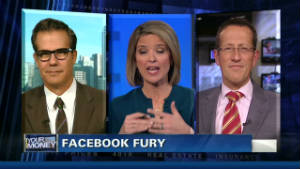
The recent deluge of Facebook changes -- both those that have already happened and those that are on the way -- have people talking.

OK ... that's an understatement. They have people shouting (with either glee or fury). And fuming. And, sometimes, freaking out.

When a site has roughly 800 million users, and each of those users has a quick and easy way to share their thoughts with others, interest is high and info starts flying fast in the face of what looks like a pretty radical overhaul.

Inevitably, that leads to things getting a bit confused sometimes. So, here's a look at some of the rumors that we've seen flying around about Facebook's big changes, along with our best effort to sort them out.

1. Facebook is going to start charging you

Do we actually have to address this one? Apparently, yes.

Every once in a while, this rumor starts cropping up in status updates -- often in all caps. Some people can't seem to get their brains around the fact that a useful service like Facebook is going to remain free. So people begin copying and pasting messages announcing the date the site is going to a pay model.

A quick glimpse and you'll find multiple "We Won't Pay For Facebook" groups. On Facebook.

So, of course, when all the new changes rolled out, the planets were aligned perfectly for the rumor to spring back up. This time, it apparently got so prevalent that Facebook addressed it.

"A rumor on the Internet caught our attention. We have no plans to charge for Facebook. It's free and always will be," the site posted on its own Facebook page.

Here's the deal: Facebook will never really have a reason to start charging you for using it. To oversimplify the situation, you aren't Facebook's customer. You're its product. The site's business model is based on advertising and it wants as many users as possible to dangle in front of the click-hungry advertisers.

Charging for Facebook would inevitably decrease the number of users. And that would decrease advertising revenue. It's not going to happen.

Verdict: False. Very false.

2. Friends will see the websites I visit, even when I'm not on Facebook

This one is partially true, with one big "if."

With what Zuckerberg called "frictionless sharing," Facebook users can have the stories they're reading on certain other websites pushed straight to their News Feed for friends to share. But this will only happen on sites with the Facebook "like" button -- and only when the user has given the site permission to share the info.

That addresses one big privacy complaint Facebook has been hit with in the past, when new features started automatically, requiring users to opt out instead of opting in.

But there's always the possibility for confusion. Some people might not realize that they're authorizing the feature or may simply forget they've enabled it. In that case, best not to make a habit of reading a bunch of articles about how to find a new job if you're FB friends with your boss.

Verdict: Partially True (If you enable it)

3. The Timeline is going to show all my photos and info (whether I want it to or not)

One of the biggest changes Facebook is making is switching users' profile pages into what's being called a Timeline. It will, in effect, make your profile look more like a blog, with a chronological stream of photos and posts from the entire time you've been on Facebook and even before.

People viewing your profile will be able to scroll through, year by year, and see what you were up to far more easily than they can now.

Reports of that have led some users to freak out, or even say they planned to delete all their photos before the feature rolls out.

Here's the deal: The Timeline will definitely make it easier for your friends to see your photos and posts, particularly older ones. A single click could take them from your recent and respectable photos from office parties and play dates to those infamous college keggers from days of yore (you know ... if you're young enough to have been on Facebook in college).

But you'll be able to curate your own timeline. You can remove photos or posts you don't want on it and resize images to emphasize (or de-emphasize) chapters of your life. At the end of the day, there will be nothing there that's not already available to prying eyes -- but the eyes just won't have to pry as hard.

Verdict: Mostly False

4. Facebook monitors my activity when I'm not logged in

This one isn't directly linked to the changes, but has cropped up as they're about to roll out. And, in truth, as more off-site sharing is introduced, it could become more prevalent.

Earlier this week, an Australian blogger posted data that he said shows information being sent to Facebook by users even when they're not logged into the site.

Facebook acknowledges that it uses "cookies" when you visit the site that then transmit data from other sites that are connected to it.

Facebook engineering director Arturo Bejar told the Wall Street Journal that the system is used to prevent phishing attacks and spam and to make it easier for users to log in on the sites they've connected to the social network. Facebook deletes the data immediately, he said, and it's never used to target advertising or the like.

"The onus is on us is to take all the data and scrub it," Bejar told the Journal. "What really matters is what we say as a company and back it up."

Verdict: True (But in a limited way)

5. I can't use Spotify unless it's linked to Facebook

This one depends: Are you already on Spotify? If so, you're in the clear. If not, or if you already signed up through your Facebook account, the two services are pretty much married, 'til digital death do they part.

To Spotify, the emerging music-streaming service, and Facebook, it's a seamless and convenient way to listen to music and share songs with your friends. To people who might want to listen privately, or those elusive few who don't have Facebook accounts, it's a hassle.

Users will still be able to use their Spotify settings to control what information gets sent to Facebook, though. So don't worry -- if you're secretly listening to lots of Bieber and Gaga on Spotify, you can still do it on the down-low.

Verdict: True (If you didn't already sign up)

Read the full article here - http://www.cnn.com/2011/09/28/tech/social-media/facebook-rumors/index.html

Monday, September 26, 2011

Actual CNN.COM Headline Today: Digital monkeys with typewriters recreate Shakespeare

http://www.cnn.com/2011/09/26/tech/web/monkeys-typewriters-shakespeare/index.html

(CNN) -- It's a time-honored adage about the laws of probability: Give 1 million monkeys 1 million typewriters and they'll eventually type the entire works of William Shakespeare.

Now, a software developer in Nevada is putting that saying to the test. And his digital monkeys are off to a good start.

This weekend, Jesse Anderson wrote on his blog that a computerized simulation of the theoretical simian typing pool has completed "A Lover's Complaint," a narrative poem that appeared in a book of The Bard's sonnets.

"This is the first time a work of Shakespeare has actually been randomly reproduced," Anderson wrote. "Furthermore, this is the largest work ever randomly reproduced. It is one small step for a monkey, one giant leap for virtual primates everywhere."

Anderson's virtual monkeys began typing on August 21. Using open-source software called Hadoop, he created a huge group of "monkeys" that input random strings of gibberish. When a chunk of text matches a word used in Shakespeare's catalogue, it gets crossed off of a database of the plays and poems.

His database comes from Project Gutenberg.

So far, he said, over 5 trillion character groups have been churned out.

Based on a page updating the project's progress, several more works might be checked off the list soon. The monkeys appear to need only two more words to complete the comedy "The Tempest" and seven more to bang out "As You Like It." (There's been no explanation for why the computer monkeys seem to be lagging behind on Shakespeare's tragedies.)

"The monkeys will continue typing away until every work of Shakespeare is randomly created," Anderson wrote.

Permutations of the Infinite Monkey Theorem dates back as far as Aristotle (although he obviously didn't have a typewriter).

Anderson's inspiration came from a perhaps less likely source: "The Simpsons."

He says it harks back to a "Simpsons" scene in which Mr. Burns chains up 1,000 monkeys, giving them the task of writing a great novel and berating one of them for typing, "It was the best of times. It was the blurst of times."

Anderson's approach is, if nothing else, gentler.

"No monkeys were harmed during the making of this code," he wrote.

Friday, September 23, 2011

Blockbuster Down But Not Out Yet as Netflix Lurches to No-Where

And just when you thought the industry was done with "power moves". See the full article from www.cnn.com here


NEW YORK (CNNMoney) -- Blockbuster was expected to launch a Netflix rival on Friday -- and it did, kind of.

"Blockbuster Movie Pass," launching October 1, bundles Dish's traditional cable TV plan with Blockbuster's DVD-by-mail service. It also includes some streaming content: a library of 3,000 movies will be available for streaming to a TV, or 4,000 if you stream to computer.

That's a small subset of the 100,000 DVDs and video games Blockbuster says it has stocked in its by-mail catalog.

The service costs $10 a month as an add-on to a Dish subscription. New customers who sign up for Dish's "America's Top 200" package for $39.99 a month -- or any more expensive service -- with a 2-year contract will receive the service for free for one year.

New subscribers who sign up for Dish's "America's Top 120" package will get Movie Pass for free for three months.

The streaming catalog includes shows from Fox, Cartoon Network, Discovery, Epix, Fox, DIY, HGTV and TBS. A more specific list of content was not immediately available.

Blockbuster has long been teasing plans to launch a streaming service to compete head-on with behemoth Netflix (NFLX), whose recent price hike has led to consumer backlash and a scaled-back subscriber forecast. Friday's move is a step in that direction, expanding Blockbuster's streaming services beyond the pay-per-rental model it currently uses.

But like Netflix, Blockbuster faces obstacles in getting monthly subscribers access to the most popular movies and TV shows. Its pay-per-rental catalog features recent releases like X-Men: First Class and Bridesmaids, priced at $3.99 for 24-hour viewing rights. Those titles aren't likely to show up in its all-you-can-watch unlimited streaming offering.

Blockbuster didn't immediately comment on what content is included in its "Movie Pass" package. The package also isn't available to non-Dish subscribers, though company executives said to "stay tuned" for later announcements on that front.

Dish Network (DISH, Fortune 500) acquired Blockbuster in April for $320 million in a bankruptcy court auction. Blockbuster's U.S. businesses filed for Chapter 11 protection in September 2010, hoping to sharply reduce their nearly $1 billion debt. The company put itself up for sale in February 2011.

Blockbuster struggled for survival ever since media conglomerate Viacom (VIA) spun off the company in 2004. Its brick-and-mortar stores were bleeding cash as traditional video renting declined, and competition from Netflix and Coinstar's (CSTR) Redbox kiosks heated up.

But Blockbuster will also face high competition in the streaming space, both direct rivals like Hulu and big tech players that are eying the space, including Amazon (AMZN, Fortune 500) and Google (GOOG, Fortune 500).

Studios and cable providers have been careful not to let any single streaming service nab all of the valuable content. As a result of carving up the streaming video market, each service offers something a little different -- and no one can boast that they let customers watch all of their favorite shows. To top of page

Tuesday, September 20, 2011

Netflix Trying to BackPedal

Great article from CNN.com - http://www.cnn.com/2011/09/20/tech/web/netflix-reaction/index.html

It has been a rough couple of months for Netflix. The company that virtually defined online movie rentals was swamped by an unprecedented wave of customer ire two months ago when it raised prices for both its DVD mailing and online streaming services.

Netflix announced this week that it's splitting itself in two and rebranding its movies-by-mail service as "Qwikster." Based on initial online responses, this latest effort didn't make things much better.

"Reed, thanks for reminding me that I should go somewhere else for my DVD rentals. It was an insult enough that you raised the price on me last month, right in the middle of the biggest recession since the Great Depression, but now instead of a sincere apology, all we get is excuses and a flimsy new name."

That's from a customer named Jonathan Ortega and it's one of more than 16,000 comments on a blog post by Netflix CEO Reed Hastings explaining the latest changes. In the post, Hastings announced that the service that made Netflix famous, mailing DVDs in those iconic red wrappers, was being spun off as Qwikster, while Web streaming video will continue to be called Netflix.

Not all the posts took the same flamethrower approach as Ortega's. But even some of the more evenhanded messages raised questions.

"While I appreciate the explanation (and e-mail) and I guess I understand your reasoning for doing this, the thing I'm having the hard time about is the separation of websites," wrote a user named Tellier Killaby Booth. "I don't understand why I will now have to go to two separate websites to manage my queues. The only reason that I have both services is because half the things I watch aren't available yet on streaming."

Chris Taylor of Mashable (a CNN content partner), questioned whether the spin-off of Qwikster was "the worst product launch since New Coke."

"As any marketer will tell you, there are some truly awful times to launch a new product -- like August, when few potential customers are paying attention, or January, when they're all shopped out from the holidays," Taylor wrote. "And then there's launching your new product in the 10th paragraph of an apology for some previous poor communication, as Netflix CEO Reed Hastings did late Sunday with Qwikster. ..."

Taylor, who says he has met and interviewed Hastings several times, calls him "one of the smartest and most amiable minds I've ever met." But he lays out a laundry list of problems, from the odd spelling of Qwikster to creating unnecessary confusion for customers who keep both streaming and DVD service.

The Internet wasn't unanimously down on Netflix's move, however.

Venture capitalist Mark Suster, who focuses on early stage tech companies, had a more positive take, calling Hastings' explanation "simply brilliant." (Worth noting: His company, GRP Partners, does not list Netflix as one of its investments.)

"[M]any short-termists will think it's a bad idea. Indeed, my Twitter stream tells me so," Suster wrote Monday on his blog. "I find much of the criticism so far fairly reactionary."

He argues that, by splitting off streaming from DVD delivery, Neflix can react more flexibly to the emerging streaming market while maintaining its hold on the mail-delivery market. Keeping them both under one umbrella would have made it harder to respond rapidly to changes in customer demands, he said.

As DVD customers decline in favor of streaming (and Suster says they inevitably will), Netflix may have to raise prices for DVD delivery, but could keep streaming prices the same under this model, he wrote.

"It's rare in business to see somebody like Reed Hastings tackle the massive changes happening to their businesses and deal with them before they're too late," he wrote. "Imagine if the record labels had been as bold. By making the separation, Reed can now point the Netflix business squarely at the future."

Tuesday, September 13, 2011

Facebook Co-Founder Speaks Out on The Network, The Google, and The Reality of Leaving a Billion Dollar Baby

San Francisco (CNN) -- The founding principles of business ethics at Facebook, according to co-founder Dustin Moskovitz, are as straightforward as the site's privacy settings system.

Many of the early developers of Facebook have moved on to work at other companies, but they operate under a specific code, Moskovitz said Monday: A great idea is a prerequisite for starting a company, businesses should be built for the long haul, and Google is not an ideal employer.

He spoke at the TechCrunch Disrupt conference in San Francisco.

Moskovitz, who was portrayed in a few scenes in the "Social Network" movie, described the dark characterization of Facebook's founding as a creation myth, contrary to authors' depictions, courtroom testimonies and the Hollywood film. He and his crew executed "with the right ethics," and the many lawsuits were handled "in exactly the right kind of way," he said.

"When you build something really big, that stuff will happen," he said of Facebook's opponents. "It was a little scary at first."

Facebook's runaway success in 2004 was clear to the founders the day after they launched the website, Moskovitz said. No amount of money would have convinced them to sell the company, he said. But that theory had certainly been tested over the years.

Like several other high-profile Facebook founders, Moskovitz left to start his own company. It's called Asana and makes project-collaboration software for businesses. Some of the ideas for Asana were conceived when he was a manger at Facebook, he said.

Moskovitz agonized over quitting Facebook and "looked for every reason to stay," he said.

"We left Facebook because we had the idea for Asana," he said. "I hated the idea of starting my own company. I really didn't want to become an entrepreneur."

Mark Zuckerberg, Moskovitz and other Facebook elite helped romanticize the concept of starting a business, Moskovitz said. He said he regrets that consequence of his success because Silicon Valley is rewarding programmers who pitch unimaginative ideas.

The goal for many is to flip their companies to a frequent shopper like Google, which competes with Facebook in many areas.

Dave Morin, another Facebook founder who left to design a social network for more intimate groups called Path, spurned an offer from Google, Moskovitz said. There, he would have been locked into "indentured servitude" because of restrictions in his contract, said Moskovitz, who is an investor in Path and advised Morin not to accept the offer.

"All of those people (from Facebook's early days) have done great work and added a lot of impact to the world and, frankly, are financially very secure," Moskovitz said. "So the only thing they're interested in now is doing that again -- you know, adding massive impact to the world and thinking about the very long run, and trying to build companies that last and really change the world for the better."

And, of course, not working for Google.

Joe Carretta
The TNS Group
Formerly known as TigerNet Systems, Inc.
Office phone: 203.316.0112 x105
Office fax: 203.316.0118
Email: jcarretta@thetnsgroup.com<sviscardi@thetnsgroup.com>

Friday, September 2, 2011

Is Larry Page the Next Bill Gates... or Something More?

Read the full article here - http://www.cnn.com/2011/09/02/tech/web/new-bill-gates-larry-page/index.html?hpt=te_t1

When Bill Gates testified via videotape in Microsoft's antitrust trial in 1998, he was combative and defensive, as if he couldn't believe how stupid the entire procedure was.

He didn't expect the tape to be shown in court. It was, and it was a disaster. Public opinion turned -- instead of a billionaire genius who had built Microsoft into the most valuable tech company in the world, he was a condescending monopolist who didn't have time for the legal system.

Amazingly, Gates didn't see it coming. As Microsoft co-founder Paul Allen relates in his recent autobiography, the anti-Microsoft sentiment "cut Bill to the core." Gates told the media that government attorney David Boies was "really out to destroy Microsoft."

In his rational engineer's mind, Microsoft was simply a winner. It had beaten its competitors by being smarter and working harder. It seemed deeply unfair for the government to build a case based on the complaints of those competitors and undo everything that Gates had worked so hard for.

Flash forward a decade.

Google is the new Microsoft. It dominates its industry so completely that a few slight tweaks to its search engine can throw other companies into turmoil by burying them in search results. It's using the incredible cash generated by that business to expand in a million different directions at once, from online video to social networking to mobile phones.

The man running Google, co-founder Larry Page, has a lot in common with Gates.

Like Gates, Page is often described in otherworldly terms, a near-genius with autistic tendencies like counting the seconds out loud while you're explaining something too slowly to him. Like Gates, he has run his own company for his entire adult life and has had uninterrupted success. Like Gates, he has an engineer's soul and is obsessive about cutting waste -- one of his first acts after taking over as CEO in April was to send an all-hands e-mail describing how to run meetings more efficiently.

Like Gates, he is hugely ambitious -- he once suggested that Google hire a million engineers and told early investors that he saw Google as a $100 billion company. That's $100 billion in annual revenue, not just stock value. (It's about one-third of the way there.)

And like Gates, Page may have a blind spot about the intersection of business and the Beltway. For instance, when Google paid $3.2 billion to buy display ad firm DoubleClick in 2007, it got a search-engine marketing firm called Performics as part of the deal. Obviously, Google would have to let Performics go -- federal regulators would never let the dominant search company own a search marketing company.

Except Page wanted to keep it, just to see how it worked. (Google sold Performics to advertising conglomerate Publicis Groupe in 2008.)

Back then, Page had a tempering force in Eric Schmidt, who was the company's CEO and was originally brought in by its investors to provide "adult supervision."

But since Page reclaimed the CEO title, the brakes are off. In his first five months, Page has reorganized the company to his liking, cut a bunch of marginal projects like Google Health and mobile app maker Slide, launched a social network to compete with Facebook and bid $12.5 billion to buy Motorola's mobile phone business.

Now, antitrust investigators are circling Google -- just like they did with Microsoft. Europe has already launched a formal investigation, and the U.S. Federal Trade Commission is taking a close look as well.

As Google keeps expanding with big, bold moves, Page will find himself thrust into the spotlight like he's never been before. For Google's sake, here's hoping he handles it with more grace than Gates.

Joe Carretta
The TNS Group
Formerly known as TigerNet Systems, Inc.
Office phone: 203.316.0112 x105
Office fax: 203.316.0118
Email: jcarretta@thetnsgroup.com<sviscardi@thetnsgroup.com>